


Share:
Home Building Guide
Our Products
Useful Tools
Home Building Guide
Products
Share:
Cement is the main strength of your home, binding sand, gravel, and water to create strong concrete that supports walls, slabs, and foundations for years. The type and grade of cement you choose directly affect the strength, durability, and resistance to water, chemicals, and weather, as well as long-term maintenance and repair costs.
Not using good cement can cause cracks, weak structures, and safety risks, while investing in the right, high-quality cement leads to a safe, durable home for generations.
Tip: Always purchase cement from trusted brands and check the manufacturing date printed on the bag. Fresh cement gives better strength and performance. |
Below are common types of cement used in home construction and other civil engineering projects, and where they work best.
OPC is the most widely used type of cement in construction. It offers reliable strength and workability, making it suitable for foundations, columns, slabs, beams, and general structural work.
OPC is ideal when you need consistent performance and faster strength gain, such as in residential buildings, commercial structures, bridges, and roads.
PPC is made by blending Portland cement with pozzolanic materials like fly ash. This improves workability, reduces absorption, and enhances long-term durability.
PPC is commonly used in home construction, plastering, and mass concrete structures like dams and bridges, where resistance to chemical attack and longer service life are important.
Tip: For regular home construction, PPC offers better durability and smooth finishing, especially in plaster and masonry work. |
Rapid hardening cement gains strength faster than OPC. This helps speed up construction where early formwork removal or quick load application is needed.
It is often used in road works, precast elements, and urgent repair jobs where time is critical.
Extra rapid hardening cement develops strength even more quickly than rapid hardening cement. It is manufactured by adding a higher percentage of accelerating compounds to OPC.
Quick-setting cement is formulated to set in a very short time. It is helpful when work must be completed quickly or when water flow cannot be stopped for long.
Tip: If you’re building near water channels or repairing wet areas, use quick-setting cement for best results. |
Low-heat cement is designed to produce less heat during hydration. This reduces the risk of thermal cracking in large concrete pours.
It is typically used in dams, massive foundations, retaining structures, and nuclear power plants where temperature control inside the concrete is important.
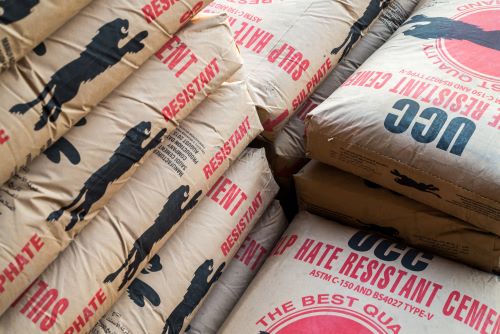
Sulphate-resistant cement is specially made to withstand sulphate salts present in soil or groundwater. These salts can damage ordinary concrete over time.
It is recommended for structures in coastal regions, canal linings, sewage treatment facilities, basements, and retaining walls exposed to sulphate-rich environments.
Blast furnace slag cement, or slag cement, is a blend of Portland clinker and blast furnace slag that improves workability and durability. Used in mass concrete, high‑rise buildings, and industrial structures.
High alumina cement is manufactured from bauxite and lime. It develops high early strength and provides excellent resistance to high temperatures and chemical corrosion.
It is commonly used in refractory concrete, furnaces, chimneys, and chemical plants where exposure to heat and harsh chemicals is expected.
White cement is similar to OPC but manufactured using raw materials with very low iron content, giving it a bright white colour.
It is mainly used for decorative and architectural designs such as exterior finishes, precast panels, terrazzo flooring, and coloured concrete when appearance matters.
Produced by adding mineral pigments to regular cement. Used for designer floors, tiles, garden paths, and facades.
Air-entraining cement incorporates air-entraining agents that create tiny, evenly distributed air bubbles in the concrete. These bubbles improve workability and resistance to freeze-thaw cycles.
It is suited for pavements, bridges, and structures in cold climates where concrete is exposed to repeated cycles of freezing and thawing.
Expansive cement is formulated to slightly expand after setting, rather than shrink like normal cement. This helps reduce cracking and ensures a tight fit in closed spaces.
It is used for grouting, anchoring bolts, precast connections, and bridge bearings, and to compensate for shrinkage in large concrete elements.
Hydrographic cement (hydrophobic or water-resistant cement) is designed to set and harden even in wet or underwater conditions. Special additives reduce water washout and improve performance in contact with water.
It is commonly used in marine construction, dams, underwater tunnels, water tanks, swimming pools, and sewage structures.
A blend of clinker and limestone, providing strength with a lower carbon footprint.
Used in pavements, foundations, green buildings, and general concrete works.
Cement grade indicates the compressive strength of cement after 28 days, measured in N/mm². Higher grades mean higher strength but may also generate more heat during hydration. Choosing the right grade depends on the structural requirements of your home.
1. 33 Grade Cement
33-grade cement achieves a minimum compressive strength of 33 N/mm² at 28 days.
It is used for general construction, masonry, and plastering, where very high strength is not necessary, and concrete grades do not exceed around M20.
2. 43 Grade Cement
It reaches 43 N/mm² and is the most popular for home construction.
Perfect for plastering, flooring, bricks, and precast work.
3. 53 Grade Cement
53-grade cement provides a minimum strength of 53 N/mm² at 28 days and is used where higher strength is required.
It is preferred for high-rise buildings, heavy-duty structures, bridges, and dams, and for higher-grade concrete above M25, with adequate curing and temperature control to avoid cracking.
Understanding basic properties of cement helps you see why one type performs better than another in certain conditions.
1. Fineness of Cement Particles
Fineness refers to how finely the cement is ground. Finer particles hydrate faster, giving higher early strength and better workability.
2. Soundness
Shows the ability to retain volume after setting. Unsound cement may crack or expand, a clear sign of poor quality.
Tip: Always perform a soundness check or buy from reputable dealers to avoid unstable cement. |
3. Consistency
Consistency measures the amount of water needed to bring cement paste to a standard, workable state.
Correct consistency ensures proper mixing, placing, and compaction, helping the concrete gain its designed strength.
4. Strength
Strength is the load-carrying capacity of hardened cement paste or concrete, usually measured in compression.
Cement strength directly affects the overall performance and safety of beams, slabs, foundations, and other load-bearing members.
5. Setting Time
Setting time refers to how long cement takes to change from a fluid paste to a solid mass. It is divided into initial and final setting times.
Adequate setting time allows for mixing, transporting, and placing concrete, while making sure it hardens soon enough to support loads and retain shape.
6. Heat of Hydration
Heat of hydration is the heat released when cement reacts with water during hydration.
In large pours, high heat can cause temperature differences and cracking, so selecting low-heat or suitable cement types is important for massive structures.
7. Loss of Ignition
Loss of ignition is the weight loss of cement when heated to high temperatures, indicating the presence of moisture, carbon dioxide, or unburnt materials.
High loss of ignition can signal poor storage or deterioration, leading to reduced strength and durability.
8. Bulk Density
Bulk density is the mass of cement per unit volume, including the spaces between particles.
It affects how cement is stored, handled, and batched by volume; consistent bulk density helps ensure correct mix proportions.
9. Specific Gravity
Specific gravity compares the density of cement to the density of water.
It is used in mix design calculations and helps decide whether the cement meets standard quality requirements.
Cement is one of the most important materials in your home, influencing its strength, durability, and safety. Different types of cement and grades are designed for specific conditions, from everyday home construction to special environments like coastal areas, cold regions, or massive foundations.
By understanding the various types of cement, their uses, grades, and key properties, you can work with your engineer or contractor to make the right choice the first time. Your home reflects your identity, and selecting the right cement ensures it stays strong and secure for generations.
For most home construction needs, PPC or OPC 43-grade works well. PPC gives better durability and a smoother finish, while OPC offers faster early strength. Your engineer may suggest a mix based on your structure and local conditions.
Not always. While 53-grade cement is very strong, it also generates more heat, which can lead to cracks if curing isn’t done correctly. It’s great for heavy-duty or high-strength work, but not always necessary for plastering or basic masonry.
Always check the manufacturing date printed on the bag. Cement should ideally be used within 3 months of production for best performance. Fresh cement feels smooth, not lumpy.
Each cement type is designed for a specific purpose; some are made for fast setting, others for underwater work, cold climates, high temperature zones, or chemical-filled environments. Choosing the right one ensures your home stays durable in various conditions.
Yes, it can. Using unsuitable cement may lead to cracks, weak bonding, moisture issues, or long-term structural problems. The right cement type and grade ensure your home stays strong, safe, and low-maintenance for years.