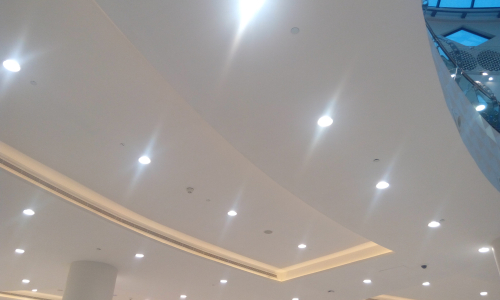
What looks better in a catalogue doesn’t always work better in a home.
Most homeowners choose a false ceiling based on design alone. But when it comes to POP vs gypsum false ceiling, the decision affects much more than aesthetics. Installation time, durability, maintenance, finishing quality, and even long-term repair costs all depend on the material you choose.
This guide breaks down the difference between POP and gypsum false ceilings, where each one works best, and what homeowners often overlook before installation begins.
What is a POP False Ceiling?
POP false ceilings have been the traditional choice in Indian homes for years, mainly because they allow more decorative and customised ceiling designs.
A POP false ceiling is made of Plaster of Paris, a white powder mixed with water to form a paste, which is applied over a mesh framework. Once dry, it hardens into a solid surface that can be shaped, carved, and finished in a variety of designs.
POP false ceilings are commonly used for:
1. Decorative and custom-shaped ceilings
2. Corner and borders
3. Curved and intricate design work
Because POP can be moulded into almost any shape, it gives designers more creative freedom than most other materials.
What homeowners need to be careful about:
The installation process is wet, time-consuming and heavily dependent on the worker’s skill. Unlike factory-made materials, the final finish depends entirely on how well the POP is mixed and applied on-site.
What is a gypsum false ceiling?
For homeowners looking for faster installation and cleaner finishing, gypsum false ceilings have become one of the most preferred modern options.
A gypsum false ceiling uses pre-manufactured gypsum boards fixed to a metal grid framework. Unlike POP, there is no mixing or wet application involved. The boards are cut to size and screwed into place, making it a dry construction process.
Gypsum false ceilings are commonly used for:
1. Office spaces and large rooms
2. Bedrooms and living rooms with straight, clean designs
3. Areas where fast installation is a priority
Gypsum false ceiling vs POP false ceiling comes down to one major difference: consistency.
Since gypsum boards are factory-manufactured, the finish is more uniform, and installation is usually quicker. POP, on the other hand, depends heavily on on-site workmanship and finishing quality.
Builder Insight: Gypsum false ceiling installation is typically 40–50% faster than POP false ceiling work. For homeowners working on a tight construction timeline, this difference matters more than most people realise.
POP vs Gypsum False Ceiling
A false ceiling is not just a design feature; it also affects maintenance, durability, installation time, and long-term upkeep.
Before making a decision, compare both materials on the factors that actually impact daily living and maintenance.
Factor
| POP False Ceiling
| Gypsum False Ceiling
|
Material
| Plaster of Paris (wet mix)
| Pre-manufactured gypsum boards
|
Installation
| Slow, skill-dependent
| Fast, dry process
|
Design Flexibility
| High (custom shapes)
| Moderate (mostly flat/linear)
|
Durability
| Moderate (crack-prone)
| High (impact resistant)
|
Cost
| Lower upfront
| Slightly higher upfront
|
Maintenance
| Higher (cracks need filling)
| Lower (boards can be replaced)
|
Weight
| Heavier
| Lighter
|
Best For
| Decorative, custom designs
| Clean, modern, fast installs
|